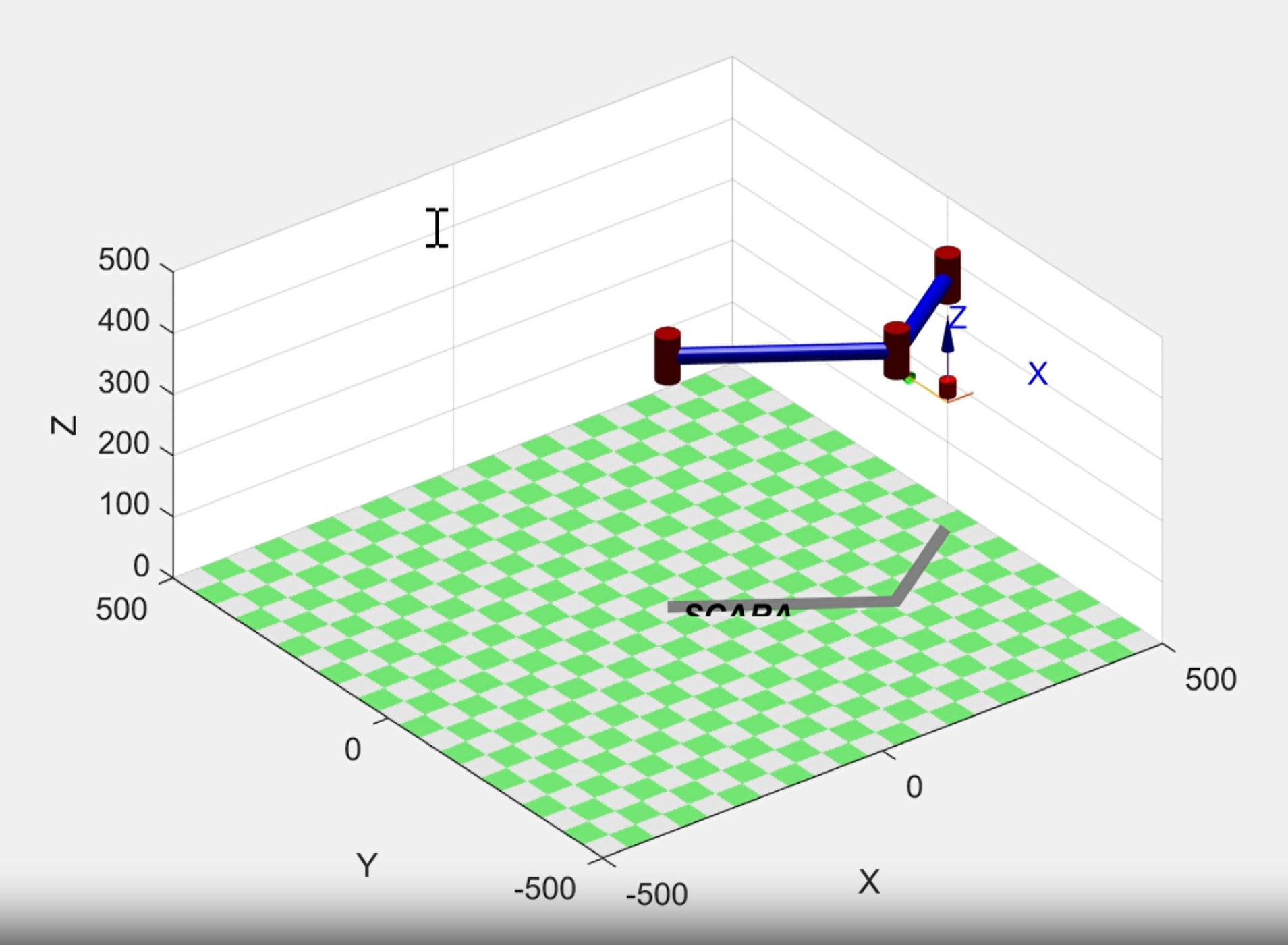
Trajectory Generation for SCARA (Mitsubishi)
Joint-space and Cartesian-space trajectory generation on a Mitsubishi SCARA robot — cubic/quintic polynomials between waypoints and parabolic blends through via points.
This project implements smooth trajectory planning for a Mitsubishi SCARA robot in a pick-and-place task. Both joint-space and Cartesian-space approaches were implemented and compared.
For point-to-point motion, cubic and quintic polynomial interpolants were generated with boundary conditions enforcing zero velocity at start and end. For multi-segment paths, parabolic blends were computed at the via points — connecting linear segments with smooth parabolic transitions that satisfy velocity and acceleration constraints without stopping at each intermediate point.
In Cartesian space, straight-line paths were planned requiring real-time inverse kinematics at each interpolated configuration. Via-point trajectories were used to route around obstacles, highlighting the tradeoffs between joint-space smoothness and Cartesian predictability near singularities.